Page 470 Acute Pain Management
P. 470
11.7 THE OPIOID-TOLERANT PATIENT
11.7.1 Definitions and clinical implications
Misunderstandings in the terminology related to addiction (see Section 11.8), tolerance, and
physical dependence may confuse health care providers and lead to inappropriate and/or
suboptimal acute pain management. Terms such as addiction, substance abuse, substance
dependence and dependence are often used interchangeably. With this in mind, a consensus
statement with agreed definitions for addiction, tolerance and physical dependence has been
developed by the American Pain Society, the American Academy of Pain Medicine and the
American Society of Addiction Medicine (AAPM et al, 2001).
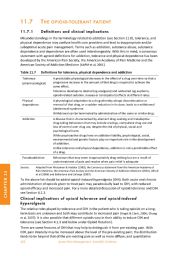
Table 11.7 Definitions for tolerance, physical dependence and addiction
Tolerance A predictable physiological decrease in the effect of a drug over time so that a
(pharmacological) progressive increase in the amount of that drug is required to achieve the
same effect.
Tolerance develops to desired (eg analgesia) and undesired (eg euphoria,
opioid‐related sedation, nausea or constipation) effects at different rates.
Physical A physiological adaptation to a drug whereby abrupt discontinuation or
dependence reversal of that drug, or a sudden reduction in its dose, leads to a withdrawal
(abstinence) syndrome.
Withdrawal can be terminated by administration of the same or similar drug.
Addiction A disease that is characterised by aberrant drug‐seeking and maladaptive
drug‐taking behaviours that may include cravings, compulsive drug use and
loss of control over drug use, despite the risk of physical, social and
psychological harm.
While psychoactive drugs have an addiction liability, psychological, social,
environmental and genetic factors play an important role in the development
of addiction.
Unlike tolerance and physical dependence, addiction is not a predictable effect
of a drug.
Pseudoaddiction Behaviours that may seem inappropriately drug seeking but are a result of
undertreatment of pain and resolve when pain relief is adequate.
Source: Adapted from Weissman & Haddox (1989), the Consensus statement from the American Academy of
Pain Medicine, the American Pain Society and the American Society of Addiction Medicine (2001), Alford
CHAPTER 11 To the above list should be added opioid‐induced hyperalgesia (OIH). Both acute and chronic
et al (2006) and Ballantyne and LaForge (2007).
administration of opioids given to treat pain may paradoxically lead to OIH, with reduced
opioid efficacy and increased pain. For a more detailed discussion of opioid tolerance and OIH
see Section 4.1.3.
Clinical implications of opioid tolerance and opioid-induced
hyperalgesia
The relative roles played by tolerance and OIH in the patient who is taking opioids on a long‐
term basis are unknown and both may contribute to increased pain (Angst & Clark, 2006; Chang
et al, 2007). It is also possible that different opioids vary in their ability to induce OIH and
tolerance (see Section 4.1.3 and below under Opioid Rotation).
There are some features of OIH that may help to distinguish it from pre‐existing pain. With
OIH, pain intensity may be increased above the level of the pre‐existing pain; the distribution
tends to be beyond that of the pre‐existing pain as well as more diffuse; and quantitative
422 Acute Pain Management: Scientific Evidence