Page 122 Guide to Pain Management in Low-Resource Settings
P. 122
110 Frank Boni
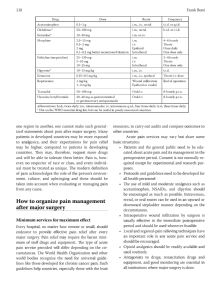
Drug Dose Route Frequency
Acetaminophen 0.5–1 g i.m., i.v., rectal t.i.d. or q.i.d.
Diclofenac* 50–100 mg i.m., rectal b.i.d. or t.i.d.
Ketorolac* 10–30 mg i.m. or i.v.
Morphine 2.5–15 mg i.m. 4–6 hourly
0.5–2 mg i.v. Titrate
2 mg Epidural Once daily
0.1–0.2 mg better recommend titration Intrathecal One dose only
Pethidine (meperidine) 25–150 mg i.m. 3–4 hourly
5–10 mg i.v. Titrate
10–25 mg Intrathecal One dose only
Dipyrone* 10–15 mg/kg i.m., i.v. t.i.d.
Ketamine 0.25–0.5 mg/kg i.m., i.v., epidural Titrate i.v. dose
Bupivacaine 1 mg/kg Wound infi ltration End of operation
1–2 mg/kg Epidural or caudal
Tramadol 50–100 mg Oral/i.v. 8-hourly p.r.n.
Hyoscine butylbromide 20–40 mg as gastrointestinal Oral/i.v. 8-hourly p.r.n.
or genitourinary antispasmodic
Abbreviations: b.i.d., twice daily; i.m., intramuscular; i.v., intravenous; q.i.d., four times daily; t.i.d., three times daily;
* Not on the WHO essential drug list, but can be useful in poorly resourced countries.
one region to another, one cannot make such general- resources, to carry out audits and compare outcomes to
ized statements about pain after major surgery. Many other countries.
patients in developed countries may be more exposed Acute pain services may vary but share some
to analgesics, and their expectations for pain relief basic structures:
may be higher, compared to patients in developing • Patients and the general public need to be edu-
countries. Th ey may, therefore, request more drugs cated about acute pain and its management in the
and will be able to tolerate them better. Pain is, how- perioperative period. Consent is not normally re-
ever, no respecter of race or class, and every individ- quired except for experimental and research pur-
ual must be treated as unique. Th e modern defi nition poses.
of pain acknowledges the role of the person’s environ- • Protocols and guidelines need to be developed for
ment, culture, and upbringing and these should be all health personnel
taken into account when evaluating or managing pain • Th e use of mild and moderate analgesics such as
from any cause. acetaminophen, NSAIDs, and dipyrine should
be encouraged as much as possible. Intravenous,
How to organize pain management rectal, or oral routes can be used in an upward or
downward stepladder manner depending on the
after major surgery
circumstances.
• Intraoperative wound infi ltration by surgeon is
Minimum services for maximum eff ect usually eff ective in the immediate postoperative
Every hospital, no matter how remote or small, should period and should be used whenever feasible.
endeavor to provide eff ective pain relief after every • Local and regional-pain relieving techniques have
major surgery. Pain relief may require the barest mini- an important role in any acute pain service and
mum of staff drugs and equipment. Th e type of acute should be encouraged.
pain service provided will diff er depending on the cir- • Opioid analgesics should be readily available and
cumstances. Th e World Health Organization and other used routinely.
world bodies recognize the need for universal guide- • Antagonists to drugs, resuscitation drugs and
lines like those developed for chronic cancer pain. Such equipment, and good monitoring are essential in
guidelines help countries, especially those with the least all institutions where major surgery is done.