Page 160 Guide to Pain Management in Low-Resource Settings
P. 160
148 M. Omar Tawfi k
Table 1
Diff erences between breakthrough and incident pain
Breakthrough Pain Incident Pain
Occurs in the same site as background pain Occurs at any site
Is spontaneous, without any volitional act Should be related to a volitional act
Has a duration and frequency Occurs with an incident and needs a
specifi c interventional treatment
Prostate cancer cells produce osteoblast-stimu- How does bone destruction occur?
lating factors, probably specifi c growth factors or acid
phosphatase. In this case, new bone is laid down di- Bone destruction results from interactions between tu-
rectly on the trabecular bone surface before osteoclas- mor cells and bone cells that are normally responsible
tic resorption. Th e resulting sclerotic metastases are for the maintenance of skeletal integrity. Th e enhanced
less prone to fracture because of the locally increased osteoclastic bone resorption, stimulated by bone-re-
bony mass. sorbing factors, is a major factor in the development of
bone metastases. Moreover, immobilization and sec-
ondary eff ects of osteolysis may be the reasons for de-
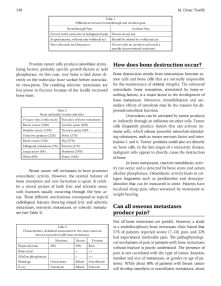
Table 2 pressed osteoblast function.
Bone metastatic lesions and sites Osteoclasts can be activated by tumor products
Primary sites in this study: Pain sites of these metastases: or indirectly through an infl uence on other cells. Tumor
Breast cancer (24%) Lumbar spine (34%) cells frequently produce factors that can activate im-
Prostate cancer (19%) Th oracic spine (33% mune cells, which release powerful osteoclast-stimulat-
Unknown primary (22%) Pelvis (27%) ing substances, such as tumor necrosis factor and inter-
Renal cancer (13%). Hip (27%) leukins 1 and 6. Tumor products could also act directly
Malignant melanoma (7%) Sacrum (17%) on bone cells. In the late stages of a metastatic disease,
Lung cancer (6%) Humerus (19%) malignant cells appear to directly cause the destruction
Other (8%) Femur (14%) of bone.
In bone metastases, reactive osteoblastic activ-
ity can occur and is detected by bone scans and serum
Breast cancer cell metastasis to bone promotes
alkaline phosphatase. Osteoclastic activity leads to col-
osteoclastic activity. However, the normal balance of
lagen fragments such as pyridinoline and deoxypyr-
bone resorption and new formation is upset. It exhib-
idinoline that can be measured in urine. Patients have
its a mixed picture of both lytic and sclerotic areas,
localized sharp pain, often worsened by movement or
with fractures usually occurring through the lytic ar-
weight bearing.
eas. Th ese diff erent mechanisms correspond to typical
radiological features showing mixed lytic and sclerotic
metastases, osteolytic metastases, or sclerotic metasta- Can all osseous metastases
ses (see Table 3). produce pain?
Not all bone metastases are painful. However, a study
Table 3 at a multidisciplinary bone metastasis clinic found that
Characteristics of skeletal assessment in the most common 57% of patients reported severe (7–10) pain, and 22%
tumors associated with bone metastases
had experienced intolerable pain. Th e pathophysiologi-
Myeloma Breast Prostate
cal mechanism of pain in patients with bone metastases
Hypercalcemia 30% 30% Rare
without fracture is poorly understood. Th e presence of
Bone scans - + ++
pain is not correlated with the type of tumor, location,
Alkaline phosphatase - + ++
number and size of metastases, or gender or age of pa-
Histology Osteoclastic Mixed Osteoblastic
tients. While about 80% of patients with breast cancer
X-ray Osteolytic Mixed Sclerotic
will develop osteolytic or osteoblastic metastases, about