Page 193 Guide to Pain Management in Low-Resource Settings
P. 193
Painful Diabetic Neuropathy 181
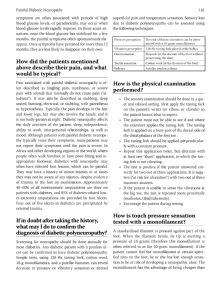
symptoms are often associated with periods of high superfi cial pain and temperature sensation. Sensory loss
blood glucose levels, or paradoxically, may occur when due to diabetic polyneuropathy can be assessed using
blood glucose levels rapidly improve. In these acute sit- the following techniques:
uations, once the blood glucose has stabilized for a few
months, the painful symptoms often spontaneously dis- Pressure perception Th e risk of future ulceration can be deter-
appear. Once symptoms have persisted for more than 12 mined with a 10-gram monofi lament
months, they are less likely to disappear on their own. Vibration perception 128-Hz tuning fork placed at the hallux
Discrimination Pinprick (at the dorsum of the foot without
penetrating the skin)
How did the patients mentioned Tactile sensation Cotton wool (at the dorsum of the foot)
above describe their pain, and what Refl exes Achilles tendon refl exes
would be typical?
Pain associated with painful diabetic neuropathy is of- How is the physical examination
ten described as tingling pain, numbness, or severe performed?
pain with stimuli that normally do not cause pain (“al-
lodynia”). It may also be described as stabbing, deep • Th e sensory examination should be done in a qui-
seated, burning, electrical, or stabbing, with paresthesia et and relaxed setting. First apply the tuning fork
or hyperesthesia. Typically, the pain develops in the feet on the patient’s wrists (or elbow, or clavicle) so
and lower legs, but may also involve the hands, and it the patient knows what to expect.
is normally greater at night. Diabetic neuropathy aff ects • Th e patient must not be able to see if and where
the daily activities of the patient: sleep, independence, the examiner applies the tuning fork. Th e tuning
ability to work, interpersonal relationships, as well as fork is applied on a bony part of the dorsal side of
mood. Although patients with painful diabetic neuropa- the distal phalanx of the fi rst toe.
thy typically voice their symptoms, many patients may • Th e tuning fork should be applied perpendicular-
not report their symptoms until the pain is severe. In ly with a constant pressure.
Africa and other developing regions in the world, where • Repeat this application twice, but alternate with
people often walk barefoot or have poor-fi tting and in- at least one “sham” application, in which the tun-
appropriate footwear, diabetics with neuropathy may ing fork is not vibrating.
often have infected foot lesions, which can be painful. • Th e test is positive if the patient answered cor-
Th ey may have a history of minor injuries or at times rectly for two out of three applications. It is nega-
they may not be aware of any injuries, despite evidence tive (“at risk for ulceration”) with two out of three
of trauma to the feet on examination. Approximately incorrect answers.
40–60% of all nontraumatic amputations are done on • If the patient is unable to sense the vibrations at
patients with diabetes, and 85% of diabetes-related low- the big toe, the test is repeated more proximally
er-extremity amputations are preceded by foot ulcers. (malleolus, tibial tuberosity).
Four out of fi ve ulcers in diabetics are precipitated by • Encourage the patient during testing.
external trauma.
How is touch pressure sensation
If in doubt after taking the history, tested with a monofi lament?
what may I do to confi rm the
diagnosis of diabetic polyneuropathy? A standardized fi lament is pressed against part of the
foot. When the fi lament bends, its tip is exerting a
Screening for neuropathy should be done annually for pressure of 10 grams (therefore this monofi lament is
most diabetics. Any diabetic patient with a painless ul- often referred to as the 10-gram monofi lament). If the
cer can be confi rmed to have diabetic polyneuropathy. patient cannot feel the monofi lament at certain speci-
Simple tests, using 128-Hz tuning fork, cotton wool, fi ed sites on the foot, he or she has lost enough sensa-
10-g monofi laments, and a patellar hammer, can reveal tion to be at risk of developing a neuropathic ulcer. Th e
decrease in pressure or vibratory sensation or altered monofi lament has the advantage of being cheaper than