Page 202 Guide to Pain Management in Low-Resource Settings
P. 202
190 Maija Haanpää and Aki Hietaharju
lack of resources, brain imaging was not available. Based How common is central
on the history and clinical fi ndings, a tentative diagno- neuropathic pain?
sis of central neuropathic pain due to a low brainstem
infarct was made. She was started on amitriptyline and Th e most common brain disease causing central pain is
prophylactic acetylsalicylic acid (100 mg/day). stroke. About 8% of patients who have had a stroke de-
velop central poststroke pain. With an annual incidence
What does “central of 117–219 per 100,000 in the European population,
and 83–329 per 100,000 in the Japanese and Chinese
neuropathic pain” mean?
population, stroke represents one of the greatest public
By defi nition, neuropathic pain arises as a direct con- health problems worldwide.
sequence of a lesion or a disease aff ecting the somato- Th e most common cause of spinal cord pain is
sensory system. In central neuropathic pain, the lesion trauma. About 70% of patients with spinal cord injury
can be located anywhere in the spinal cord or the brain, are aff ected with central neuropathic pain. It has been
aff ecting the spinothalamocortical pathways (Fig. 1). estimated that the annual incidence of spinal cord injury
Th erefore, the older concept of “thalamic pain” is in- in diff erent countries throughout the world varies from
correct: the lesion may be at any level of the central 15 to 40 cases per million.
nervous system (CNS). Musculoskeletal and visceral Th e prevalence of neuropathic pain is not
nociceptive pains are also common in patients with known in rarer conditions, such as syringomyelia or spi-
CNS diseases caused by conditions such as spasticity nal tuberculosis. Although central neuropathic pain is
or bladder dysfunction, but these pains are not includ- relatively uncommon, its impact should not be under-
ed in the concept of central neuropathic pain. Acute estimated, because it is diffi cult to treat and causes dis-
headaches caused by a stroke or head trauma are not ability and suff ering to those aff ected.
regarded as neuropathic pain, either. Th ey are classifi ed
as secondary headaches and are due to distension or ir- What are the clinical characteristics
ritation of meninges. of central neuropathic pain?
A common feature of central neuropathic pain is al-
What diseases can cause central
tered function of the spinothalamic tract, which medi-
neuropathic pain? ates temperature and pain sensations. Hence, abnormal
temperature or pain perception or both is found in sen-
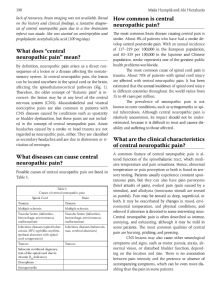
Possible causes of central neuropathic pain are listed in
sory testing. Patients usually experience constant spon-
Table 1.
taneous pain, but they can also have pain paroxysms
(brief attacks of pain), evoked pain (pain caused by a
Table 1 stimulus), and allodynia (innocuous stimuli are sensed
Causes of central neuropathic pain
as painful). Pain may be sensed as deep, superfi cial, or
Spinal Cord Brain
both. It may be exacerbated by changes in mood, envi-
Trauma Trauma
ronmental temperature, and physical conditions, and
Multiple sclerosis Multiple sclerosis
relieved if attention is directed to some interesting issue.
Vascular lesion (infarction, Vascular lesion (infarction,
hemorrhage, arteriovenous hemorrhage, arteriovenous Central neuropathic pain is often described as intense,
malformation) malformation) annoying, and exhausting, although it may be mild in
Infectious diseases (spinal tuber- Infectious diseases (tuberculo- some patients. Th e most common qualities of central
culosis, HIV, syphilitic myelitis, mas, cerebral abscesses) pain are burning, pricking, and pressing.
epidural abscesses with spinal
cord compression) CNS lesions may also cause other neurological
Tumors Tumors symptoms and signs, such as motor paresis, ataxia, ab-
Subacute combined degenera- normal vision, or disturbed bladder function, depend-
tion of the spinal cord due to ing on the location and size. Th ere is no association
vitamin B defi ciency
12 between pain intensity and the presence or absence of
Dysraphism
accompanying symptoms, which can be even more dis-
Syringomyelia
abling than the pain in some patients.