Page 209 Guide to Pain Management in Low-Resource Settings
P. 209
Management of Pain in HIV/AIDS 197
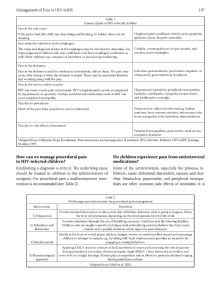
Table 1
Causes of pain in HIV-infected children
Pain in the oral cavity
If the pain is bad, the child may stop eating and drinking. In babies, there may be Oropharyngeal candidiasis, dental caries, gingivitis,
drooling. aphthous ulcers, herpetic stomatitis
Pain related to infections in the esophagus
Th e cause and diagnosis of pain in the esophagus may be very hard to determine. Im- Candida, cytomegalovirus, herpes simplex, and
munosuppressed children with oral candidiasis may have esophageal candidiasis as mycobacterial esophagitis
well. Older children may complain of heartburn or pain during swallowing.
Pain in the abdomen
Pain in the abdomen could be constant or intermittent, dull or sharp. Th e pain may Infectious gastroenteritis, pancreatitis, hepatitis, or
occur after eating or when the stomach is empty. Th ere may be associated diarrhea infrequently, gastrointestinal lymphoma
and vomiting along with the pain
Pain in the nerves and/or muscles
HIV can cause muscle pain or joint pain. HIV encephalopathy can be accompanied Hypertonicity/spasticity, peripheral neuropathies,
by hypertonicity or spasticity. Certain antiretroviral medications such as D4T can headache, myelopathy, myopathy, herpes zoster,
cause peripheral neuropathy. and postherpetic neuralgia
Pain due to procedures
Much of the pain from procedures can be minimized. Venipuncture, tuberculin skin testing, lumbar
puncture, bone marrow aspirates, intravenous infu-
sions, nasogastric tube insertions, immunizations
Pain due to side eff ects of treatment
Peripheral neuropathies, pancreatitis, renal stones,
myopathy, headache
*Adapted from Children’s Hope Foundation. Pain assessment and management of pediatric HIV infection. Pediatric HIV/AIDS Training
Module; 1997.
How can we manage procedural pain Do children experience pain from antiretroviral
in HIV-infected children? medications?
Establishing a diagnosis is critical. Th e underlying cause Many of the antiretrovirals, especially the protease in-
should be treated in addition to the administration of hibitors, cause abdominal discomfort, nausea, and diar-
analgesia. For procedural pain a multicomponent inter- rhea. Headaches, pancreatitis, and peripheral neuropa-
vention is recommended (see Table 2). thies are other common side eff ects of treatment. It is
Table 2
Multicomponent intervention for procedural pain management
Intervention Procedure
Provide detailed information on the events that will follow. Rehearse what is going to happen. Tailor
1) Preparation the level of information depending on the developmental level of the child.
Promote relaxation through the use of breathing exercises. Could use aids like blowing bubbles.
2) Relaxation and Children who are taught a specifi c technique such as breathing exercises believe they have more
distraction control over a painful situation, which improves pain tolerance.
Mostly in the form of verbal praise, stickers, badges, sweets, or small toys that reward and encourage
children to attempt to comply, e.g., by sitting still. Such reinforcement provides an incentive for
3) Reinforcement engaging in coping behaviors.
Applying EMLA (eutectic mixture of local anesthetics) cream and increasing the role of parents
during procedures can reduce distress and pain. Apply EMLA 1 hour before the procedure and
4) Pharmacological cover with an airtight bandage. Parents play an important role in eff orts to promote children’s coping
approach during painful procedures.
*Adapted from Schiff et al. 2001.