Page 368 Guide to Pain Management in Low-Resource Settings
P. 368
356 Barbara Schlisio
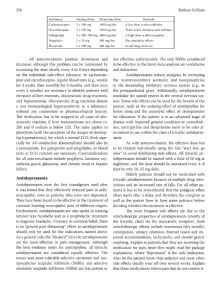
Substance Starting Dose Maximum Dose Remarks
Carbamazepine 3 × 100 mg 1600 mg/day A low dose is often eff ective
Oxcarbazepine 3 × 150 mg 2250 mg/day Th ere is less dizziness and sedation
Gabapentin 3 × 100–300 mg 3600 mg/day A high dose is often required
Pregabalin 2 × 25 mg 300 mg/day Has anxiolytic eff ects
Phenytoin 1 × 100 mg 400 mg/day Avoid long-term use
All anticonvulsants produce drowsiness and not eff ective, unfortunately. Th e only SNRIs considered
dizziness, although this problem can be minimized by to be eff ective in the latest meta-analysis are venlafaxine
increasing the dose slowly, every 4 to 8 days depending and duloxetine.
on the individual side-eff ect tolerance. In carbamaze- Antidepressants induce analgesia by increasing
pine and oxcarbazepine, regular blood tests (e.g., weekly the neurotransmitters serotonin and norepinephrine
for 4 weeks, then monthly for 3 months, and then once in the descending inhibitory nervous system (e.g., in
every 3 months) are necessary to identify patients with the periaqueductal gray). Additionally, antidepressants
elevation of liver enzymes, idiosyncratic drug reactions, modulate the opioid system in the central nervous sys-
and hyponatremia. Idiosyncratic drug reactions denote tem. Some side eff ects can be used for the benefi t of the
a non-immunological hypersensitivity to a substance, patient, such as the sedating eff ect of amitriptyline for
without any connection to pharmacological toxicity. better sleep and the anxiolytic eff ect of clomipramine
Th e medication has to be stopped in all cases of idio- for relaxation. If the patient is in an advanced stage of
syncratic reaction, if liver transaminases are above ca. disease with impaired general condition or comorbidi-
200 and if sodium is below 125. Th e same applies to ties, nortriptyline and desipramine seem to be safer al-
phenytoin (with the exception of the danger of develop- ternatives to use within the class of tricyclic antidepres-
ing hyponatremia), for which a normal ECG (look espe- sants.
cially for AV-conduction abnormalities) should also be As with anticonvulsants, the eff ective dose has
a prerequisite. For gabapentin and pregabalin, no blood to be titrated individually using the rule “start low, go
tests or ECG controls are necessary. Contraindications slow” to avoid debilitating side eff ects. All tricyclic an-
for all anticonvulsants include porphyria, lactation, my- tidepressants should be started with a dose of 10 mg at
asthenia gravis, glaucoma, and chronic renal or hepatic nighttime, and the dose should be increased every 4–8
failure. days by only 10–25 mg daily.
Elderly patients should not be medicated with
Antidepressants tricyclic antidepressants because of multiple drug inter-
Antidepressants were the fi rst coanalgesics used after actions and an increased rate of falls. For all other pa-
it was found that they eff ectively reduced pain in poly- tients it has to be remembered that the analgesic eff ect
neuropathy, even in patients who were not depressed. often starts after a delay, and therefore the caregiver as
Th ey have been found to be eff ective in the treatment of well as the patient have to have some patience before
constant burning neuropathic pain of diff erent origins. deciding whether the treatment is eff ective.
Furthermore, antidepressants are also useful in treating Th e most frequent side eff ects are due to the
tension type headache and as a prophylactic treatment anticholinergic properties of antidepressants (mostly of
in migraine headache. Contrary to common belief, there the tricyclic class) via the muscarinic receptors. Such
is no “general pain-distancing” eff ect, so antidepressants anticholinergic eff ects include xerostomia (dry mouth),
should only be used for the indications named above. constipation, urinary retention, blurred vision and im-
As a general rule, the “classical” tricyclic antidepressants paired accommodation, tachycardia, and slowed gastric
are the most eff ective in pain management. Although emptying. Explain to patients that they are receiving the
the best evidence exists for amitriptyline, all tricyclic medication for pain, since they might read the package
antidepressants are considered equally eff ective. Th e explanation, where “depression” is the only indication.
newer and more tolerable selective serotonin and nor- Also let the patient know that sedation and most other
epinephrine reuptake inhibitors (SNRIs) and selective side eff ects usually wear off over several weeks. Explain
serotonin reuptake inhibitors (SSRIs) are less potent or that these medications relieve pain but do not resolve it.