Page 445 Acute Pain Management
P. 445
11.2.1 Pharmacokinetic and pharmacodynamic changes
The changes in physiology and effects on pharmacokinetics and pharmacodynamics in older
people, and consequent alterations that might be required in some drug regimens are
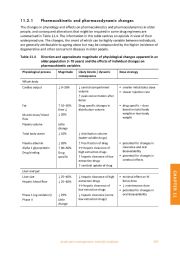
summarised in Table 11.4. The information in this table centres on opioids in view of their
widespread use. The changes, the onset of which can be highly variable between individuals,
are generally attributable to ageing alone but may be compounded by the higher incidence of
degenerative and other concurrent diseases in older people.
Table 11.4 Direction and approximate magnitude of physiological changes apparent in an
older population (> 70 years) and the effects of individual changes on
pharmacokinetic variables
Physiological process Magnitude Likely kinetic / dynamic Dose strategy
consequence
Whole body
Cardiac output ↓ 0–20% ↓ central compartment smaller initial bolus dose
volume slower injection rate
↑ peak concentration after
bolus
Fat ↑ 10–50% Drug specific changes in drug specific – dose
then ↓ distribution volume based on total body
Muscle mass/ blood ↓ 20% weight or lean body
flow weight
Plasma volume Little
change
Total body water ↓ 10% ↓ distribution volume
(water‐soluble drugs)
Plasma albumin ↓ 20% ↑ free fraction of drug potential for changes in
Alpha 1 glycoprotein ↑ 30–50% ↔ hepatic clearance of clearance and oral
Drug binding Drug high extraction drugs bioavailability
specific ↑ hepatic clearance of low potential for changes in
extraction drugs cerebral effects
↑ cerebral uptake of drug
Liver and gut
Liver size ↓ 25–40% ↓ hepatic clearance of high minimal effect on IV
Hepatic blood flow ↓ 25–40% extraction drugs bolus dose
↔ hepatic clearance of ↓ maintenance dose CHAPTER 11
low extraction drugs potential for changes in
Phase 1 (eg oxidation) ↓ 25% ↓ hepatic clearance (some oral bioavailability
Phase II Little low extraction drugs)
change
Acute pain management: scientific evidence 397