Page 446 Acute Pain Management
P. 446
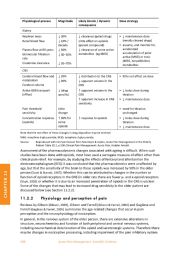
Physiological process Magnitude Likely kinetic / dynamic Dose strategy
consequence
Kidney
Nephron mass ↓ 30% ↓ clearance (polar) drugs ↓ maintenance dose
Renal blood flow ↓ 10% / Little effect on opioids (renally cleared drugs)
decade (parent compound) assume, and monitor for,
Plasma flow at 80 years ↓ 50% ↓ clearance of some active accelerated
Glomerular filtration ↓ 30–50% metabolites (eg M6G) accumulation of polar
rate active (M6G) or toxic
Creatinine clearance ↓ 50–70% (M3G, norpethidine)
metabolites
CNS
Cerebral blood flow and ↓ 20% ↓ distribution to the CNS little net effect on dose
metabolism ↓ 20% ↓ apparent volume in the
Cerebral volume CNS
Active BBB transport ↓ (drug ↑ apparent volume in the ↓ bolus dose during
(efflux) specific) CNS titration
↑ apparent increase in CNS ↓ maintenance dose
sensitivity
Pain threshold Little need for titration
sensitivity change unchanged
Concentration response ↑ 50% for ↑ response to opioids ↓ bolus dose during
(opioids) some titration
opioids ↓ maintenance dose
Note that the net effect of these changes in drug disposition may be minimal
M6G: morphine‐6‐glucuronide; M3G: morphine‐3‐glucuronide.
Source: Reproduced with kind permission from Macintyre & Upton, Acute Pain Management in the Elderly
Patient Table 28.1, p 506 Clinical Pain Management: Acute Pain, Hodder Arnold.
Assessment of the pharmacodynamic changes associated with ageing is difficult. When such
studies have been done with opioids, most have used a surrogate measure of effect other than
clinical pain relief. For example, by studying the effects of fentanyl and alfentanil on the
electroencephalogram (EEG) it was concluded that the pharmacokinetics were unaffected by
age, but that the sensitivity of the brain to these opioids was increased by 50% in the older
CHAPTER 11 function of opioid receptors in the CNS (in older rats there are fewer μ‐ and κ‐opioid receptors
person (Scott & Stanski, 1987). Whether this can be attributed to changes in the number or
(Vuyk, 2003) or whether it is due to an increased penetration of opioids in the CNS is unclear.
Some of the changes that may lead to increased drug sensitivity in the older patient are
discussed below (see Section 11.2.2).
11.2.2
Physiology and perception of pain
Reviews by Gibson (Gibson, 2003), Gibson and Farrell (Gibson & Farrell, 2004) and Gagliese and
Farrell (Gagliese & Farrell, 2005) summarise the age‐related changes that occur in pain
perception and the neurophysiology of nociception.
In general, in the nervous system of the older person, there are extensive alterations in
structure, neurochemistry and function of both peripheral and central nervous systems,
including neurochemical deterioration of the opioid and serotonergic systems. Therefore there
may be changes in nociceptive processing, including impairment of the pain inhibitory system.
398 Acute Pain Management: Scientific Evidence