Page 137 Guide to Pain Management in Low-Resource Settings
P. 137
Pharmacological Management of Pain in Obstetrics 125
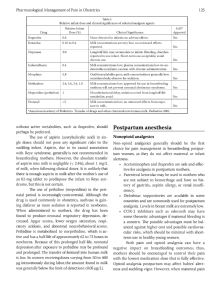
Table 1
Relative infant dose and clinical signifi cance of selectedanalgesic agents
Relative Infant AAP*
Drug Dose (%) Clinical Signifi cance Approval
Ibuprofen 0.6 None detected in infants; no adverseeff ects. Yes
Ketorolac 0.16 to 0.4 Milk concentrations arevery low; no untoward eff ects
reported. Yes
Naproxen 3.0 Longhalf-life; may accumulate in infant. Bleeding, diarrhea
reportedin one infant. Short-term use acceptable; avoid
chronic use. Yes
Indomethacin 0.4 Milkconcentrations low; plasma concentrations low-to-un-
detectablein infants; caution with chronic administration. Yes
Morphine 5.8 Oralbioavailability poor; milk concentrations generally low;
consideredsafe; observe for sedation. Yes
Methadone 2.6, 5.6, 2.4, 1.0 Milkconcentrations low; approved for use in breastfeeding
mothers;will not prevent neonatal abstinence syndrome. Yes
Meperidine (pethidine) 1 Neurobehavioral delay, sedation noted from longhalf-life
metabolite; avoid. Yes
Fentanyl <3 Milk concentrationslow; no untoward eff ects from expo-
sure in milk. Yes
*AmericanAcademy of Pediatrics. Transfer of drugs and other chemicalsinto human milk. Pediatrics 2001.
without active metabolites, such as ibuprofen, should Postpartum anesthesia
perhaps be preferred.
Th e use of aspirin (acetylsalicylic acid) in sin- Nonopioid analgesics
gle doses should not pose any signifi cant risks to the Non-opioid analgesics generally should be the fi rst
suckling infant. Aspirin, due to its causal association choice for pain management in breastfeeding postpar-
with Reye syndrome, generally is not recommended in tum women, as they do not aff ect maternal or infant
breastfeeding mothers. However, the absolute transfer alertness.
of aspirin into milk is negligible (< 2.4%), about 1 mg/L • Acetaminophen and ibuprofen are safe and eff ec-
of milk, when following clinical doses. It is unlikely that tive for analgesia in postpartum mothers.
there is enough aspirin in milk after the mother’s use of • Parenteral ketorolac may be used in mothers who
an 82-mg tablet to predispose the infant to Reye syn- are not subject to hemorrhage and have no his-
drome, butthis is not certain. tory of gastritis, aspirin allergy, or renal insuffi -
Th e use of pethidine (meperidine) in the peri- ciency.
natal period is increasingly controversial. Although the • Diclofenac suppositories are available in some
drug is used commonly in obstetrics, such use is gain- countries and are commonly used for postpartum
ing disfavor as more sedation is reported in newborns. analgesia. Levels in breast milk are extremely low.
When administered to mothers, the drug has been • COX-2 inhibitors such as celecoxib may have
found to produce neonatal respiratory depression, de- some theoretic advantages if maternal bleeding is
creased Apgar scores, lower oxygen saturation, respi- a concern. Th e possible advantages must be bal-
ratory acidosis, and abnormal neurobehavioral scores. anced against higher cost and possible cardiovas-
Pethidine is metabolized to norpethidine, which is ac- cular risks, which should be minimal with short-
tive and has a half-life of approximately 62 to 73 hours in term use in healthy young women.
newborns. Because of this prolonged half-life, neonatal Both pain and opioid analgesia can have a
depression after exposure to pethidine may be profound negative impact on breastfeeding outcomes; thus,
and prolonged. Th e transfer of fentanyl into human milk mothers should be encouraged to control their pain
is low. In women receiving doses varying from 50 to 400 with the lowest medication dose that is fully eff ective.
μg intravenously during labor, the amount found in milk Opioid analgesia postpartum may aff ect babies’ alert-
was generally below the limit of detection(<0.05 μg/L). ness and suckling vigor. However, when maternal pain