Page 140 Guide to Pain Management in Low-Resource Settings
P. 140
128 Katarina Jankovic
oxide in oxygen. It was introduced in clinical practice are inadequate for mid-forceps delivery (see paragraph
more than 100 years ago, and it remains a standard on “pudendal and paracervical block”).
analgesia method in obstetrics departments (“anaes-
thesia de la reine”). Later on, other inhalation (“vola- If epidural analgesia is available,
tile”) agents such as halothane also came into use. Th e which patients will benefi t most?
parturient self-administers the anesthetic gas using
a hand-held face mask. Th e safety of this technique Indications for epidural analgesia include maternal re-
is that the parturient will be unable to hold the mask quest, anticipated diffi culty with intubation for surgi-
if she becomes too drowsy, and thus will cease to in- cal delivery, a history of malignant hyperthermia, some
hale the anesthetic. It is easy to administer and safe for cardiovascular and respiratory disorders, AV malforma-
both mother and fetus. Th e analgesia is considered to tions, brain tumors, and morbid obesity, as well as pre-
be superior to opioids, but less eff ective than epidural eclampsia and HELLP syndrome (hemolytic anemia, el-
analgesia. Although there are data on maternal desatu- evated liver enzymes, and low platelet count).
ration, recent studies have not demonstrated any ad- Absolute contraindications include patient re-
verse eff ects on mothers or neonates. Inhalation agents fusal, allergy (although “true” allergy to local anesthetics
such as 0.25–1% enfl urane and 0.2–0.25% isofl urane is rare), coagulopathy (to avoid spinal/epidural hema-
in nitrous oxide have given better analgesia in labor toma; negative history is considered suffi ciently eff ective
than nitrous oxide alone. Desfl urane has been used to identify patients at risk), skin infections at the site of
as 1–4.5% in oxygen for the second stage of labor, but needle entry (to avoid epidural abscess formation), hy-
23% of women reported unwanted amnesia during the povolemia (to avoid profound hypotension from the
period of usage. sympathetic block that comes with epidural analgesia
of the lumbar and sacral segments), and increased in-
What is a simple and eff ective tracranial pressure (herniation of the cerebral contents
regional anesthesia method for the through the foramen magnum with distal pressure loss
after dural puncture).
second stage of labor that is easy
to learn and may be applied by the
non-anesthetist? If epidural analgesia is used,
could it be a single-shot technique?
Th e pudendal nerve block is useful for alleviating pain Which drugs should be selected,
arising from vaginal and perineal distension during the
and where should the catheter
second stage of labor. It may be used as a supplement should be placed?
for epidural analgesia if the sacral nerves are not suffi -
ciently anesthetized, and as a supplement for systemic For labor analgesia, epidural catheters are usually in-
analgesia. Pudendal nerve blocks may also be performed serted at the level of L2–3 or L3–4. Th e main drugs
to provide analgesia for low-forceps delivery, but they used for this method are local anesthetics and opioids.
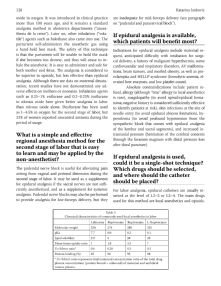
Table 3
Chemical characteristics of commonly used local anesthetics in labor
Lidocaine Ropivacaine Bupivacaine L-Bupivacaine
Molecular weight 234 274 288 325
pKa 7.7 8.0 8.2 8.1
Lipid solubility 2.9 3 28 25
Mean tissue uptake ratio 1 1.8 3.3 ?
Uv/Mvtot ratio* 0.6 0.28 0.3 0.3
Protein binding (%) 65 98 95 98
* Uv/Mvtot ratio represents fetal/maternal concentration ratio of the total drug
plasma concentration (protein bound + unbound) of maternal and umbilical
venous plasma.