Page 47 Guide to Pain Management in Low-Resource Settings
P. 47
Pharmacology of Analgesics (Excluding Opioids) 35
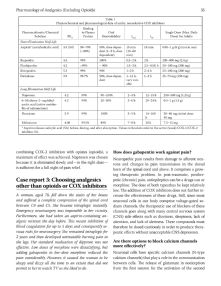
Table 1
Physicochemical and pharmacological data of acidic, nonselective COX inhibitors
Binding
Pharmacokinetic/Chemical to Plasma Oral Single Dose (Max. Daily
Subclass PK Protein Bioavailability t t Dose) for Adults
A max 50
Short Elimination Half-Life
Aspirin* (acetylsalicylic acid) 3.5 (3.0) 50–70% 50%, dose depen- 15 min 15 min 0.05–1 g (6 g) (not in use)
(~80%) dent (1–5 h, dose (15–60
dependent) min)
Ibuprofen 4.4 99% 100% 0.5–2 h 2 h 200–800 mg (2.4 g)
Flurbiprofen 4.2 >99% ~ 90% 1.5–3 h 2.5–4 (8) h 50–100 mg (200 mg)
Ketoprofen 5.3 99% 90% 1–2 h 2–4 h 25–100 mg (200 mg)
Diclofenac 3.9 99.7% 50%, dose depen- 1–12 h, 1–2 h 25–75 mg (150 mg)
dent very vari-
able
Long Elimination Half-Life
Naproxen 4.2 99% 90–100% 2–4 h 12–15 h 250–500 mg (1.25 g)
6–Methoxy-2–naphthyl- 4.2 99% 20–50% 3–6 h 20–24 h 0.5–1 g (1.5 g)
acetic acid (active metabo-
lite of nabumetone)
Piroxicam 5.9 99% 100% 3–5 h 14–160 20–40 mg; initial dose:
h 40 mg
Meloxicam 4.08 99.5% 89% 7–8 h 20 h 7.5–15 mg
* Aspirin releases salicylic acid (SA) before, during, and after absorption. Values in brackets refer to the active (weak) COX-1/COX-2
inhibitor SA.
combining COX-2 inhibition with opiates (opioids), a How does gabapentin work against pain?
maximum of eff ect was achieved. Naproxen was chosen
Neuropathic pain results from damage to aff erent neu-
because it is eliminated slowly and—in the right dose—
rons and changes in pain transmission in the dorsal
is suffi cient for a full night of pain relief.
horn of the spinal cord and above. It comprises a grow-
ing therapeutic problem. In post-traumatic, posther-
Case report 3: Choosing analgesics petic (chronic) pain, antiepileptics can be a drugs can or
other than opioids or COX inhibitors morphine. Th e dose of both typesthus be kept relatively
low. Th e addition of COX inhibitors does not further in-
A woman, aged 78, fell down the stairs of her house crease the eff ectiveness of these drugs. Still, since most
and suff ered a complete compression of the spinal cord neuronal cells in our body comprise voltage-gated so-
between C4 and C5. She became tetraplegic instantly. dium channels, the therapeutic use of blockers of these
Emergency neurosurgery was impossible in her vicinity. channels goes along with many central nervous system
Furthermore, she had taken an aspirin-containing an- (CNS) side eff ects such as dizziness, sleepiness, lack of
algesic mixture the day before. Th is meant inhibition of attention, and lack of alertness. Th ese compounds must
blood coagulation for up to 5 days and consequently se- therefore be dosed cautiously in order to produce thera-
rious risks for neurosurgery. She remained tetraplegic for peutic eff ects without unacceptable CNS depression.
2 years and then developed untreatable burning pain in
the legs. Her standard medication of dipyrone was not Are there options to block calcium channels
eff ective. Low doses of morphine were dissatisfying, but more eff ectively?
adding gabapentin to low-dose morphine reduced the Neuronal cells have specifi c calcium channels (N-type
pain considerably. However, it caused the woman to be calcium channels) that play a role in the communication
sleepy and dizzy all the time to an extent that did not between cells. Th e release of glutamate in nociception
permit to her to watch TV as she liked to do. from the fi rst neuron for the activation of the second