Page 52 Guide to Pain Management in Low-Resource Settings
P. 52
40 Michael Schäfer
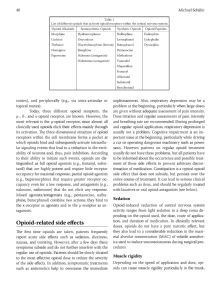
Table 1
List of diff erent opioids that activate opioid receptors within the central nervous system
Opioid Alkaloids Semisynthetic Opioids Synthetic Opioids Opioid Peptides
Morphine Hydromorphone Nalbuphine Endorphin
Codeine Oxycodone Levorphanol Enkephalin
Th ebaine Diacetylmorphine (heroin) Butorphanol Dynorphin
Noscapine Etorphine Pentazocine
Papaverine Naloxone (antagonist) Methadone
Naltrexone (antagonist) Tramadol
Meperidine
Fentanyl
Alfentanil
Sufentanil
Remifentanil
routes), and peripherally (e.g., via intra-articular or unpleasantness. Also, respiratory depression may be a
topical routes). problem at the beginning, particularly when large doses
Today, three diff erent opioid receptors, the are given without adequate assessment of pain intensity.
μ-, δ-, and κ-opioid receptor, are known. However, the Dose titration and regular assessments of pain intensity
most relevant is the μ-opioid receptor, since almost all and breathing rate are recommended. During prolonged
clinically used opioids elicit their eff ects mainly through and regular opioid application, respiratory depression is
its activation. Th e three-dimensional structure of opioid usually not a problem. Cognitive impairment is an im-
receptors within the cell membrane forms a pocket at portant issue at the beginning, particularly while driving
which opioids bind and subsequently activate intracellu- a car or operating dangerous machinery such as power
lar signaling events that lead to a reduction in the excit- saws. However, patients on regular opioid treatment
ability of neurons and, thus, pain inhibition. According usually do not have these problems, but all patients have
to their ability to initiate such events, opioids are dis- to be informed about the occurrence and possible treat-
tinguished as full opioid agonists (e.g., fentanyl, sufen- ment of these side eff ects to prevent arbitrary discon-
tanil) that are highly potent and require little receptor tinuation of medication. Constipation is a typical opioid
occupancy for maximal response, partial opioid agonists side eff ect that does not subside, but persists over the
(e.g., buprenorphine) that require greater receptor oc- entire course of treatment. It can lead to serious clinical
cupancy even for a low response, and antagonists (e.g., problems such as ileus, and should be regularly treated
naloxone, naltrexone) that do not elicit any response. with laxatives or oral opioid antagonists (see below).
Mixed agonists/antagonists (e.g., pentazocine, nalbu-
Sedation
phine, butorphanol) combine two actions: they bind to
the κ-receptor as agonists and to the μ-receptor as an- Opioid-induced reduction of central nervous system
tagonists. activity ranges from light sedation to a deep coma de-
pending on the opioid used, the dose, route of applica-
Opioid-related side eff ects tion, and duration of medication. In clinically relevant
doses, opioids do not have a pure narcotic eff ect, but
Th e fi rst time opioids are taken, patients frequently they also lead to a considerable reduction in the maxi-
report acute side eff ects such as sedation, dizziness, mal alveolar concentration (MAC) of volatile anesthet-
nausea, and vomiting. However, after a few days these ics used to induce unconsciousness during surgical pro-
symptoms subside and do not further interfere with the cedures.
regular use of opioids. Patients should be slowly titrated
Muscle rigidity
to the most eff ective opioid dose to reduce the severity
of the side eff ects. In addition, symptomatic treatments Depending on the speed of application and dose, opi-
such as antiemetics help to overcome the immediate oids can cause muscle rigidity particularly in the trunk,