Page 388 Acute Pain Management
P. 388
Key messages
The following tick boxes represent conclusions based on clinical experience and expert
opinion.
Pain assessment and measurement are important components of paediatric pain
management (U).
Pain measurement tools are available for children of all ages (U).
Pain measurement tools must be matched to the age and development of the child, be
appropriate for the clinical context and be explained and used consistently (U).
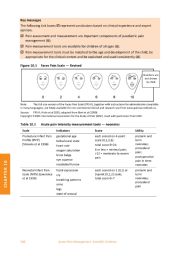
Figure 10.1 Faces Pain Scale — Revised
Numbers are
not shown
to child
Note: The full‐size version of the Faces Pain Scale (FPS‐R), together with instructions for administration (available
in many languages), are freely available for non‐commercial clinical and research use from www.painsourcebook.ca.
Source: FPS‐R; Hicks et al 2001; adapted from Bieri et al (1990).
Copyright ©2001 International Association for the Study of Pain (IASP). Used with permission from IASP.
Table 10.1 Acute pain intensity measurement tools — neonates
Scale Indicators Score Utility
Premature Infant Pain gestational age each scored on 4‐point preterm and
Profile (PIPP) behavioural state scale (0,1,2,3); term
(Stevens et al 1996) heart rate total score 0–21; neonates;
oxygen saturation 6 or less = minimal pain; procedural
pain;
brow bulge >12 = moderate to severe postoperative
pain
eye squeeze
pain in term
CHAPTER 10 Neonatal Infant Pain facial expression each scored on 2 (0,1) or preterm and
nasolabial furrow
neonates
Scale (NIPS) (Lawrence
3‐point (0,1,2) scale;
term
cry
neonates;
total score 0–7
et al 1993)
breathing patterns
arms
pain
legs procedural
state of arousal
340 Acute Pain Management: Scientific Evidence