Page 50 Acute Pain Management
P. 50
is the C‐fibre polymodal nociceptor, which responds to a broad range of physical (heat, cold,
pressure) and chemical stimuli. Thermal sensation is detected by a range of transient receptor
potential (TRP) channels (Patapoutian et al, 2009). A number of receptors have been postulated
to signal noxious mechanical stimuli, including acid‐sensing ion channels (ASICs), TRPs and
potassium channels (Woolf & Ma, 2007).
Tissue damage, such as that associated with infection, inflammation or ischaemia, produces
disruption of cells, degranulation of mast cells, secretion by inflammatory cells, and induction
of enzymes such as cyclo‐oxygenase‐2 (COX‐2). Ranges of chemical mediators act either
directly via ligand‐gated ion channels or via metabotropic receptors to activate and/or
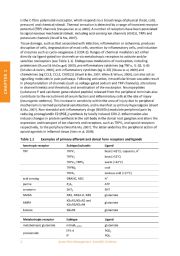
sensitise nociceptors (see Table 1.1). Endogenous modulators of nociception, including
proteinases (Russell & McDougall, 2009), pro‐inflammatory cytokines (eg TNFα, IL‐1β, IL‐6)
(Schafers & Sorkin, 2008), anti‐inflammatory cytokines (eg IL‐10) (Sloane et al, 2009) and
CHAPTER 1 chemokines (eg CCL3, CCL2, CX3CL1) (Woolf & Ma, 2007; White & Wilson, 2008), can also act as
signalling molecules in pain pathways. Following activation, intracellular kinase cascades result
in phosphorylation of channels (such as voltage‐gated sodium and TRP channels), alterations
in channel kinetics and threshold, and sensitisation of the nociceptor. Neuropeptides
(substance P and calcitonin gene‐related peptide) released from the peripheral terminals also
contribute to the recruitment of serum factors and inflammatory cells at the site of injury
(neurogenic oedema). This increase in sensitivity within the area of injury due to peripheral
mechanisms is termed peripheral sensitisation, and is manifest as primary hyperalgesia (Woolf
& Ma, 2007). Non‐steroidal anti‐inflammatory drugs (NSAIDs) modulate peripheral pain by
reducing prostaglandin E2 (PGE 2) synthesis by locally induced COX‐2. Inflammation also
induces changes in protein synthesis in the cell body in the dorsal root ganglion and alters the
expression and transport of ion channels and receptors, such as TRPV 1 and opioid receptors
respectively, to the periphery (Woolf & Ma, 2007). The latter underlies the peripheral action of
opioid agonists in inflamed tissue (Stein et al, 2009).
Table 1.1 Examples of primary afferent and dorsal horn receptors and ligands
Ionotropic receptor Subtype/subunits Ligand
+
TRP TRPV 1 heat (>42°C), capsaicin, H
TRPV 2 heat (>53°C)
TRPV 3 , TRPV 4 warm (>32°C)
TRPM 8 cool
TRPA 1 noxious cold (<17°C)
+
acid sensing DRASIC, ASIC H
purine P 2 X 3 ATP
serotonin 5HT 3 5HT
NMDA NR1, NR2A‐D, NR3 glutamate
iGluR1/iGluR2 and
AMPA glutamate
iGluR3/iGluR4
kainate iGluR5 glutamate
Metabotropic receptor Subtype Ligand
metabotropic glutamate mGluR 1,2/3,5 glutamate
EP1‐4 PGE 2
prostanoids
IP PGI 2
2 Acute Pain Management: Scientific Evidence