Page 183 Guide to Pain Management in Low-Resource Settings
P. 183
Hematologic Cancer with Nausea and Vomiting 171
What chemotherapy agents cause
the most problems with nausea
and vomiting?
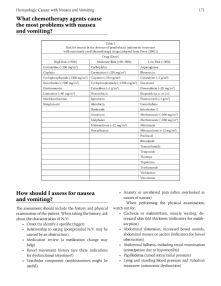
Table 1
Risk for emesis in the absence of prophylactic antiemetic treatment
with commonly used chemotherapy drugs [adapted from Perry (2001)]
Drug (Dose)
High Risk (>90%) Moderate Risk (≥30–90%) Low Risk (<30%)
Carmustine (>250 mg/m ) Carboplatin Asparaginase
2
2
Cisplatin Carmustine (<250 mg/m ) Bleomycin
2
2
2
Cyclophosphamide (1500 mg/m ) Cisplatin (<50 mg/m ) Cytarabine (<1 g/m )
2
Dacarbazine (>500 mg/m ) Cyclophosphamide (<1500 mg/m ) Docetaxel
2
2
2
Dactinomycin Cytarabine (>1 g/m ) Doxorubicin (<20 mg/m )
2
Lomustine (>60 mg/m ) Doxorubicin Etoposide (p.o. or i.v.)
2
Mechlorethamine Epirubicin Fluorouracil (<1 g/m )
Streptozocin Idarubicin Gemcitabine
Ifosfamide Interleukin-2
2
Irinotecan Methotrexate (<100 mg/m )
2
Melphalan Methotrexate (>100 mg/m )
2
Mitoxantrone (>12 mg/m ) Mitomycin
2
Procarbazine Mitoxantrone (<12 mg/m )
Paclitaxel
Rituximab
Temozolomide
Teniposide
Th iotepa
Topotecan
Trastuzumab
Vinblastine
Vincristine
How should I assess for nausea • Anxiety or unrelieved pain (often overlooked as
and vomiting? causes of nausea)
When performing the physical examination,
Th e assessment should include the history and physical watch out for:
examination of the patient. When taking the history, ask • Cachexia or malnutrition, muscle wasting, de-
about the characteristics of N/V: creased skin fold thickness (indicators for malab-
• Onset (to identify a specifi c trigger) sorption)
• Relationship to eating (postprandial N/V may be • Abdominal distension, increased bowel sounds,
caused by an obstruction) abdominal masses or ascites (indicators for bowel
• Medication review (a medication change may obstruction)
help) • Abdominal fullness, including rectal examination
• Bowel movement history (are there indications (constipation due to hypomotility)
for dysfunctional intestines?) • Papilledema (raised intracranial pressure)
• Vestibular component (antihistamines might be • Lying and standing blood pressure and Valsalva’s
useful) maneuver (autonomic dysfunction)