Page 184 Guide to Pain Management in Low-Resource Settings
P. 184
172 Justin Baker et al.
How can nausea and vomiting be Can you treat nausea and vomiting
treated pharmacologically? with nonpharmacological options
(complementary and alternative
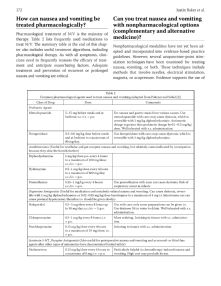
Pharmacological treatment of N/V is the mainstay of
therapy. Table 2 lists frequently used medications to medicine)?
treat N/V. Th e summary table at the end of this chap-
Nonpharmacological modalities have not yet been ad-
ter also includes useful treatment algorithms, including
opted and incorporated into evidence-based practice
pharmacological therapy. As with all symptoms, clini-
guidelines. However, several acupuncture-point stim-
cians need to frequently reassess the effi cacy of treat-
ulation techniques have been examined for treating
ment and anticipate exacerbating factors. Adequate
nausea, vomiting, or both. Th ese techniques include
treatment and prevention of recurrent or prolonged
methods that involve needles, electrical stimulation,
nausea and vomiting are critical.
magnets, or acupressure. Evidence supports the use of
Table 2
Common pharmacological agents used to treat nausea and vomiting (adapted from Policzer and Sobel [3])
Class of Drug Dose Comments
Prokinetic Agents
Metoclopramide 5–15 mg before meals and at For nausea and gastric stasis from various causes. Use
bedtime; s.c./i.v. = p.o. metoclopramide with care; may cause dystonia, which is
reversible with 1 mg/kg diphenhydramine. Antiemetic
dosage is greater than prokinetic dosage by 0.1–0.2 mg/kg/
dose. Well tolerated with s.c. administration.
Domperidone 0.3–0.6 mg/kg dose before meals Use domperidone with care; may cause dystonia, which is
and at bedtime to a maximum of reversible with 1 mg/kg diphenhydramine.
80 mg/day.
Antihistamines (Useful for vestibular and gut receptor nausea and vomiting, but relatively contraindicated by constipation
because they slow the bowels further)
Diphenhydramine 1 mg/kg/dose p.o. every 4 hours
to a maximum of 100 mg/dose;
s.c./i.v. = p.o.
Hydroxyzine 0.5–1 mg/kg/dose every 4 hours
to a maximum of 600 mg/day;
s.c./i.v. = p.o.
Promethazine 0.25–1 mg/kg every 4 hours; Use promethazine with care; can cause dystonia. Risk of
s.c./i.v. = p.o. respiratory arrest in infants
Dopamine Antagonists (Useful for medication and metabolic-related nausea and vomiting. Can cause dystonia, revers-
ible with 1 mg/kg diphenhydramine or 0.02–0.05 mg/kg/dose benztropine to a maximum of 4 mg i.v. Intravenous use can
cause postural hypotension; therefore i.v. should be given slowly.)
Haloperidol 0.5–5 mg/dose every 8 hours up Use with care; only some preparations can be given i.v.
to 30 mg/day; s.c./i.v. = ½ p.o. Use dextrose 5% in water to dilute. Well tolerated with s.c.
administration.
Chlorpromazine 0.5–1 mg/kg every 8 hours; i.v. More sedating. Irritating to tissues with s.c. administra-
= p.o. tion.
Prochlorperazine 0.15 mg/kg/dose every 4 hours Irritating to tissues with s.c. administration.
to a maximum of 10 mg/dose; i.v.
= p.o.
Serotonin 5-HT Receptor Antagonists (Also useful for postoperative nausea and vomiting and as second- or third-line
3
agents after other types of antiemetics have demonstrated limited utility)
Ondansetron 0.15 mg/kg/dose every 6 hours to Particularly helpful in chemotherapy-induced nausea and
a maximum of 8 mg; i.v. = p.o. vomiting. High cost may preclude its use.