Page 186 Guide to Pain Management in Low-Resource Settings
P. 186
174 Justin Baker et al.
What are the side eff ects
of therapy?
All medications have a primary eff ect and side eff ects.
Antiemetics should be chosen mainly on the basis of the
etiology of the N/V and the mechanism of the medica-
tion. Side eff ects may hinder the ability to use certain
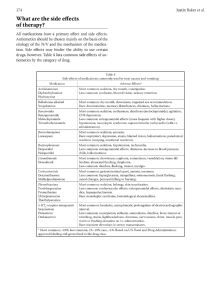
drugs, however. Table 4 lists common side eff ects of an-
tiemetics by the category of drug.
Table 4
Side eff ects of medications commonly used to treat nausea and vomiting
Medication Adverse Eff ects*
Antihistamines Most common: sedation, dry mouth, constipation.
Diphenhydramine Less common: confusion, blurred vision, urinary retention.
Hydroxyzine
Belladonna alkaloid Most common: dry mouth, drowsiness, impaired eye accommodation.
Scopolamine Rare: disorientation, memory disturbances, dizziness, hallucinations.
Benzamides Most common: sedation, restlessness, diarrhoea (metoclopramide), agitation,
Benzquinamide CNS depression.
Metoclopramide Less common: extrapyramidal eff ects (more frequent with higher doses),
Trimethobenzamide hypotension, neuroleptic syndrome, supraventricular tachycardia (with i.v.
administration).
Benzodiazepines Most common: sedation, amnesia.
Lorazepam Rare: respiratory depression, ataxia, blurred vision, hallucinations, paradoxical
reactions (weeping, emotional reactions).
Butyrophenones Most common: sedation, hypotension, tachycardia.
Droperidol Less common: extrapyramidal eff ects, dizziness, increase in blood pressure,
Haloperidol chills, hallucinations.
Cannabinoids Most common: drowsiness, euphoria, somnolence, vasodilation, vision dif-
Dronabinol fi culties, abnormal thinking, dysphoria.
Less common: diarrhea, fl ushing, tremor, myalgia.
Corticosteroids Most common: gastrointestinal upset, anxiety, insomnia.
Dexamethasone Less common: hyperglycemia, myopathies, osteonecrosis, facial fl ushing,
Methylprednisolone mood changes, perineal itching or burning.
Phenothiazines Most common: sedation, lethargy, skin sensitization.
Prochlorperazine Less common: cardiovascular eff ects, extrapyramidal eff ects, cholestatic jaun-
Promethazine dice, hyperprolactinemia.
Chlorpromazine Rare: neuroleptic syndrome, hematological abnormalities.
Th iethylperazine
5-HT -receptor antagonists Most common: headache, asymptomatic prolongation of electrocardiographic
3
Granisetron interval.
Dolasetron Less common: constipation, asthenia, somnolence, diarrhea, fever, tremor or
Ondansetron twitching, ataxia, lightheadedness, dizziness, nervousness, thirst, muscle pain,
warm or fl ushing sensation on i.v. administration.
Rare: transient elevations in serum transaminases.
* Most common; >10%; less common, 1%–10%; rare, <1%. Based on U.S. Food and Drug Administration-
approved labeling and generalized to the drug class.