Page 54 Guide to Pain Management in Low-Resource Settings
P. 54
42 Michael Schäfer
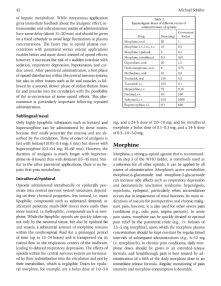
of hepatic metabolism. While intravenous application Table 2
gives immediate feedback about the analgesic eff ect, in- Equianalgesic doses of diff erent routes of
tramuscular and subcutaneous routes of administration administrations of opioids
have some delay (about 15–20 min) and should be given Conversion
Drug Dose (mg) Factor
on a fi xed schedule to avoid large fl uctuations in plasma
Morphine, oral 30 1
concentrations. Th e faster rise in opioid plasma con-
Morphine, i.v., i.m., s.c. 10 0.3
centration with parenteral versus enteral applications
Morphine, epidural 3 0.1
enables better and more direct control of opioid eff ects;
Morphine, intrathecal 0.3 0.01
however, it increases the risk of a sudden overdose with
Oxycodone, oral 20 1.5
sedation, respiratory depression, hypotension, and car-
Hydromorphone, oral 8 3.75
diac arrest. After parenteral administration, a fi rst phase
Methadone, oral 10 0.3
of opioid distribution within the central nervous system,
Tramadol, oral 150 0.2
but also in other tissues such as fat and muscles, is fol-
Tramadol, i.v. 100 0.1
lowed by a second, slower phase of redistribution from
Meperidine, i.v. 75 0.13
fat and muscles into the circulation with the possibility
Fentanyl, i.v. 0.1 100
of the re-occurrence of some opioid eff ects. Th is phe-
Sufentanil, i.v. 0.01 1000
nomenon is particularly important following repeated
Buprenorphine, s.l. 0.3 100
administration.
Sublingual/nasal
Only highly lipophilic substances such as fentanyl and mg, and a 24-h dose of 3.0–10 mg; and for intrathecal
buprenorphine can be administered by these routes, morphine a bolus dose of 0.1–0.3 mg, and a 24-h dose
because they easily penetrate the mucosa and are ab- of 0.3–1.0–5.0 mg.
sorbed by the circulation. Time of onset of analgesia is
fast with fentanyl (0.05–0.3 mg; 5 min) but slower with Morphine
buprenorphine (0.2–0.4 mg; 30–60 min). However, the
duration of analgesia is much longer with buprenor- Morphine, a strong μ-opioid agonist that is recommend-
phine (6–8 hours) than with fentanyl (15–45 min). Sim- ed in step 3 of the WHO ladder, is commonly used as
ilar to the other parenteral applications, there is no he- a reference for all other opioids. It can be applied by all
patic fi rst-pass metabolism. routes of administration. Morphine’s active metabolites
morphine-6-glucuronide and morphine-3-glucuronide
Intrathecal/epidural can increase side eff ects such as respiratory depression
Opioids administered intrathecally or epidurally pen- and neurotoxicity (excitation syndrome: hyperalgesia,
etrate into central nervous system structures depend- myoclonia, epilepsia), particularly when accumulation
ing on their chemical properties: less ionized, i.e. more occurs due to impairment of renal function. Its main in-
lipophilic, compounds such as sufentanil, fentanyl, or dications of use are for postoperative and chronic malig-
alfentanil penetrate much (800 times) more easily than nant pain; however, it is also used for other severe pain
more ionized, i.e. hydrophilic, compounds such as mor- conditions (e.g., colic pain, angina pectoris). In acute
phine. While the lipophilic opioids are quickly taken up, pain states, morphine can be quickly titrated to optimal
not only by the neuronal tissue, but also by epidural fat pain relief by the parenteral route (e.g., i.v. boluses of
and vessels, a substantial amount of morphine remains 2.5–5 mg morphine), upon which the morphine plasma
within the cerebrospinal fl uid for a prolonged period concentration should be kept constant by regular timed
of time (up to 12–24 hours) and is transported via its intervals of subsequent administrations (e.g., 6–12 mg
rostral fl ow to the respiratory centers of the midbrain, i.v. morphine/h). In chronic pain conditions, daily mor-
leading to delayed respiratory depression. Th e eff ects of phine doses should be given in an extended-release
opioids within the central nervous system are terminat- formula, and breakthrough pain is best treated by ad-
ed by their redistribution into the circulation and not by ministration of a fi fth of the daily morphine dose in an
their metabolism, which is negligible. Doses for epidu- immediate-release formula. Regular monitoring of pain
ral morphine, for example, are a bolus dose of 1.0–3.0 intensity and morphine consumption is desirable.