Page 61 Guide to Pain Management in Low-Resource Settings
P. 61
Principles of Palliative Care 49
Th e national cancer unit was based in the capi- only for a drug regimen, but also for a palliative care
tal city over 250 km away from her village, and once her plan tailored to individual needs and the patient’s situa-
pain was controlled and the radiotherapy was fi nished, tion and context. It is also important to try to assess the
she wanted to go back home. As well as being nearer to cause of any pain or symptoms that the individual might
her children, she could not aff ord the expense of being in be experiencing, and if the cause is treatable, e.g., an op-
hospital, and she was worried that the children would portunistic infection, then it is important to treat the
not be being looked after properly by her elderly mother- cause as well as manage the symptom.
in-law. She was aware of her diagnosis of cancer, and the
doctors were concerned that she might have an underly-
What should be done for baseline
ing condition of HIV, particularly as her husband had assessment?
died of “unknown causes.” She was, however, reluctant to
have an HIV test due to the stigma that she may experi- Th e baseline assessment should include a minimum
ence if it came back positive, and due to the advanced set of information elicited by the health professional
stage of her disease, having an HIV diagnosis was unlike- to help provide information about the context of care,
ly to alter the course of treatment. She was worried about e.g., age, sex, underlying disease, care setting, ongoing
the future of her two children aged 12 and 14 years, and therapy (medical as well as traditional and comple-
concerned whether her mother-in-law would be able to mentary therapies), and previous treatments. Th e de-
support them if she died. Th ese problems were addressed scription of the care setting should include where the
with repeated talks with Grace about issues surrounding patient lives, who provides care, how many people
the health of her children, both of whom seemed to be in there are at home, and an overview of fi nancial and
good health. Grace was referred to a local home-based emotional resources and the needs of the patient and
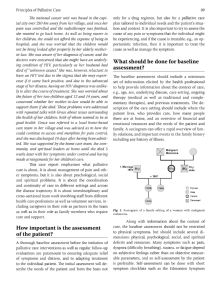
care team in her village and was advised as to how she family. A sociogram can off er a rapid overview of fam-
could continue to access oral morphine for pain control, ily relations, and important events in the family history
and she was discharged 10 days after having been admit- including any history of illness.
ted. She was supported by the home care team, the com-
munity, and spiritual leaders at home until she died 5
weeks later with her symptoms under control and having
made arrangements for her children’s care.
Th is case report emphasizes what palliative
care is about. It is about management of pain and oth-
er symptoms, but it is also about psychological, social
and spiritual problems. It is about the coordination
and continuity of care in diff erent settings and across
the disease trajectory. It is about interdisciplinary and
cross-sectional team work involving staff from diff erent
health care professions as well as volunteer services, in-
cluding caregivers in their role as partners in the team
as well as in their role as family members who require Fig. 1. Sociogram of a family setting of a woman with malignant
melanoma.
care and support.
Along with information about the context of
How important is the assessment care, the baseline assessment should not be restricted
of the patient? to physical symptoms, but should include several di-
mensions: physical, psychological, social, and spiritual
A thorough baseline assessment before the initiation of defi cits and resources. Many symptoms such as pain,
palliative care interventions as well as regular follow-up dyspnea (diffi culty breathing), nausea, or fatigue depend
evaluations are paramount to ensuring adequate relief on subjective feelings rather than on objective measur-
of symptoms and distress, and to adapting treatment able parameters, and so self-assessment by the patient
to the individual patient. Th e initial assessment will de- is preferable. Self-assessment can be done with short
scribe the needs of the patient and form the basis not symptom checklists such as the Edmonton Symptom