Page 62 Guide to Pain Management in Low-Resource Settings
P. 62
50 Lukas Radbruch and Julia Downing
Assessment Score (ESAS), which uses numerical rating regular re-assessment should be maintained, as further
scales (NRS) or visual analogue scales (VAS) to assess deterioration from the underlying disease is to be ex-
intensity of the most important symptoms. Th e pallia- pected. Cancer patients or HIV/AIDS patients receiving
tive care outcome score (POS) is a more comprehensive palliative care should be seen weekly, or at least monthly
instrument that tries to include all dimensions of care if the situation is stable, by the health care professional.
in 12 questions. An African version has been developed Follow-up assessments can be brief, but should include
that has been used with good eff ect in resource-poor short symptom checklists to monitor whether new
settings. However, many patients with advanced dis- symptoms have appeared. Treatment for new symptoms
eases and with declining cognitive and physical function and problems should be initiated. Th e POS can be used
will not be able to complete even short self-assessment on a regular basis to assess the patient’s status, and on-
instruments. Assessment by caregivers or staff is usually going therapies should also be re-evaluated regularly, to
a close substitute for the patient’s self-assessment and see whether they still are indicated or whether careful
should be implemented for such patients. dose reduction or even withdrawal might be advisable.
Assessment of psychological, spiritual, and so- However, it should be noted that often drugs for the re-
cial issues can be more complex, with limited tools be- lief of pain, dyspnea, and other symptoms must be con-
ing available to aid the health care professional. How- tinued until the time of death. Symptomatic treatment
ever, simple tools can be used for this purpose, such as can be discontinued if treatment of an underlying cause
FICA for assessing spiritual needs, i.e., Faith or beliefs, of the symptoms is possible (for example an opportunis-
Importance and infl uence, Community, and Addressing tic infection in patients with HIV/AIDS).
the issues. Following the death of the patient, an evaluation
Performance status is an important parameter of the overall effi cacy of the palliative care delivered is
because it predicts needs. Performance status is also useful for quality assurance purposes. Th e easiest way
well suited for evaluation and monitoring of services, as is to ask caregivers and family members for an overall
it describes the patient population cared for. Th e East- evaluation of the patient’s care a few weeks or months
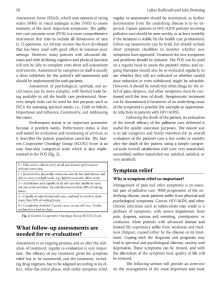
ern Cooperative Oncology Group (ECOG) Score is an after the death of the patient, using a simple categori-
easy four-step categorical scale which is also imple- cal scale (overall satisfaction with care: very unsatisfi ed,
mented in the POS (Fig. 2). unsatisfi ed, neither unsatisfi ed nor satisfi ed, satisfi ed, or
very satisfi ed).
0 = Fully active, able to carry on all pre-disease performance
without restriction.
Symptom relief
1 = Restricted in physically strenuous activity but ambulatory and
able to carry out light work, e.g., light housework, offi ce work. Why is symptom relief so important?
2 = Ambulatory and capable of all self-care but unable to carry Management of pain and other symptoms is an essen-
out any work activities. Up and about more than 50% of waking
hours. tial part of palliative care. With progression of the un-
3 = Capable of only limited self-care, confi ned to a bed or chair derlying disease, most patients suff er from physical and
more than 50% of waking hours. psychological symptoms. Cancer, HIV/AIDS, and other
4 = Completely disabled. Cannot carry on any self-care. Totally chronic infections such as tuberculosis may result in a
confi ned to a bed or chair.
plethora of symptoms, with severe impairment from
Fig. 2. Eastern Cooperative Oncology Group (ECOG) Scale. pain, dyspnea, nausea and vomiting, constipation, or
confusion. Most patients with advanced disease and
What follow-up assessments are limited life expectancy suff er from weakness and tired-
needed for re-evaluation? ness (fatigue), caused either by the disease or its treat-
ment. Coping with the diagnosis and prognosis may
Assessment is an ongoing process, and so after the initi- lead to spiritual and psychological distress, anxiety, and
ation of treatment, regular re-evaluation is very impor- depression. Th ese symptoms can be treated, and with
tant. Th e effi cacy of any treatment given for symptom the alleviation of the symptom load, quality of life will
relief has to be monitored, and the treatment, includ- be restored.
ing drug regimen, has to be adapted according to its ef- Th e following section will provide an overview
fect. After the initial phase, with stable symptom relief, on the management of the most important and most