Page 64 Acute Pain Management
P. 64
as the magnitude and duration of the response is related to the magnitude and duration of the
stimulus, effective pain relief can have a significant impact on the injury response (Liu & Wu,
2008; Carli & Schricker, 2009).
Release of proinflammatory cytokines may contribute to postoperative ileus, but the impact of
modulating this response on overall patient outcome requires further evaluation. Intravenous
lignocaine infusion attenuated postoperative increases in pro‐inflammatory cytokines, such as
IL‐6 (interleukin‐6), IL‐8 and IL‐1RA (a competitive inhibitor of IL‐1β) and was associated with
more rapid return of bowel function following abdominal surgery (Kuo et al, 2006 Level II;
Herroeder et al, 2007 Level II). Reductions in pain scores and opioid consumption were found in
only one study (Kuo et al, 2006 Level II). Benefits of lignocaine were more marked when
administered via the thoracic epidural route than by intravenous infusion (Kuo et al, 2006
Level II).
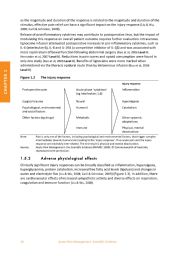
CHAPTER 1 Figure 1.2 The injury response Acute phase ‘cytokines’ Injury response
Inflammation
Postoperative pain
Neural
Surgical trauma (eg Interleukins 1,6) Hyperalgesia
Psychological, environmental Humoral Catabolism
and social factors
Other factors (eg drugs) Metabolic Other systemic
adaptations
Immune Physical, mental
deactivation
Note: Pain is only one of the factors, including psychological and environmental factors, that trigger complex
intermediates (neural, humoral etc) leading to the ‘injury response’. Thus acute pain and the injury
response are inevitably inter‐related. The end result is physical and mental deactivation.
Source: Acute Pain Management: the Scientific Evidence (NHMRC 1999); © Commonwealth of Australia,
reproduced with permission.
1.5.2 Adverse physiological effects
Clinically significant injury responses can be broadly classified as inflammation, hyperalgesia,
hyperglycaemia, protein catabolism, increased free fatty acid levels (lipolysis) and changes in
water and electrolyte flux (Liu & Wu, 2008; Carli & Schricker, 2009) (Figure 1.3). In addition, there
are cardiovascular effects of increased sympathetic activity and diverse effects on respiration,
coagulation and immune function (Liu & Wu, 2008).
16 Acute Pain Management: Scientific Evidence